
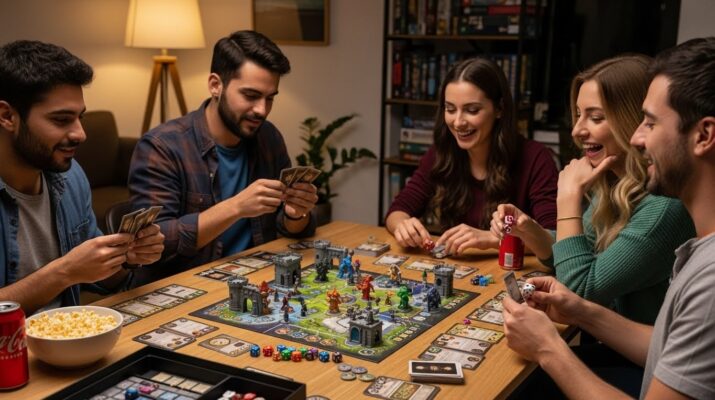
In the modern era, gaming has evolved from a casual pastime into a dynamic and multi-faceted industry. With technological advancements and the creative ingenuity of developers, games now span a vast spectrum, from hyper-realistic simulations to abstract experiences that challenge the mind in unexpected ways. While many players gravitate toward blockbuster titles and familiar genres, there exists a rich world of games that break the mold and offer unique, unforgettable experiences. In this blog post, we explore some of these games and what makes them truly extraordinary.
The Rise of Experimental Games
Traditionally, games were judged on graphics, mechanics, and storyline. However, experimental games challenge this standard by redefining what a game can be. These are not simply products for entertainment; they are artistic expressions, thought experiments, and social commentaries. Developers in this space often prioritize creativity over convention, giving players experiences that provoke thought and evoke emotions rarely seen in mainstream gaming.
One key aspect of experimental games is their ability to tell stories in unconventional ways. Instead of linear narratives or predictable arcs, these games allow players to shape the story, explore symbolic worlds, or even confront abstract ideas. The focus shifts from “winning” to “experiencing,” creating a more personal connection between player and game.
Games That Play With Time
Time manipulation is a fascinating theme in game design. Some games give players control over time itself, allowing them to rewind, pause, or accelerate the flow of events. This mechanic opens up gameplay possibilities that traditional linear games cannot offer. For instance, a player may solve puzzles by reversing mistakes, manipulate environments to their advantage, or explore parallel timelines that reveal hidden stories.
The allure of time-based mechanics lies not only in clever gameplay but also in the philosophical questions they raise. How does altering time affect decision-making? What consequences emerge when the natural order is disrupted? Games that experiment with time often blur the line between play and introspection, inviting players to reflect on life’s own temporality.
Games as Emotional Experiences
While many games prioritize action and achievement, some focus entirely on eliciting emotions. These games explore feelings like nostalgia, melancholy, wonder, and empathy, demonstrating that games can be as emotionally profound as films or literature. Titles in this category often feature minimalistic gameplay but rely heavily on atmosphere, music, and narrative cues to immerse the player.
The beauty of emotionally driven games lies in their subtlety. They do not demand mastery or high scores but instead encourage presence and introspection. Players may find themselves moved by a simple interaction, a fleeting visual, or a story told entirely without words. These experiences underscore the power of games as a medium for human expression.
Physical and Interactive Games
Not all games exist solely in the digital realm. Physical and interactive games that blend real-world activity with gameplay mechanics are gaining popularity. From escape rooms to augmented reality experiences, these games emphasize immersion and active participation. Players navigate physical spaces, solve puzzles, and interact with others, creating a unique sense of presence that screen-based games often cannot replicate.
Interactive games highlight the social and communal aspects of play. They transform ordinary environments into stages for adventure and encourage collaboration and creativity. By merging reality and imagination, these games provide an experience that is as tangible as it is imaginative.
Games That Challenge Perception
Some games stand out by directly challenging how we perceive the world. They manipulate perspective, gravity, or physics to create mind-bending experiences that defy conventional logic. In these games, movement and environment are puzzles in themselves, and players must rethink their assumptions to progress.
Challenging perception fosters a deeper engagement with the mechanics and world design. It transforms routine actions like walking, jumping, or looking around into exercises in problem-solving and spatial reasoning. Players often find themselves in awe of the cleverness behind these designs, which make even the simplest actions feel novel.
Narrative-Driven Games Without Dialogue
Narrative is central to many games, but some developers experiment with storytelling without words. These games rely on environmental cues, visual symbolism, and player interpretation to convey a story. Every object, lighting choice, and sound effect becomes a piece of the narrative puzzle, inviting players to immerse themselves and draw personal conclusions.
The absence of dialogue encourages a more active form of storytelling. Players become co-creators, piecing together events and meaning from subtle hints. This style fosters a unique form of engagement where each player’s experience is deeply personal, offering multiple interpretations of the same game world.
Games as Artistic Statements
Art and games have long intersected, but some titles embrace this intersection explicitly. These games use gameplay as a canvas, turning mechanics, visuals, and sound into expressions of artistic vision. They may explore abstract concepts, surreal landscapes, or aesthetic experiences that defy traditional notions of entertainment.
Artistic games challenge players to slow down and appreciate the craft behind every pixel, note, and animation. The goal is not to conquer but to experience, reflect, and perhaps even be transformed by the encounter. These games prove that play can be a profound form of art, capable of evoking thought, beauty, and emotion.
Social Commentary Through Play
Games have also emerged as platforms for social commentary. By embedding political, cultural, or ethical themes into gameplay, developers can provoke reflection and conversation in ways that other media cannot. Some games ask players to confront moral dilemmas, navigate societal structures, or experience life from another perspective, creating empathy and awareness.
Socially conscious games highlight the potential of gaming as a tool for education and advocacy. They demonstrate that play is not merely a diversion but a medium through which players can explore complex ideas, challenge assumptions, and engage with issues in an interactive, immersive way.
The Role of Indie Developers
Many of the most unique and experimental games come from independent developers. Free from the pressures of large-scale production and mass-market appeal, indie studios can take risks and pursue unconventional ideas. This creative freedom has led to a surge of games that defy categorization, offering experiences that mainstream titles rarely attempt.
Indie games often focus on innovation and personal vision. Developers are willing to explore niche genres, unusual aesthetics, or experimental mechanics that larger studios might avoid. The indie scene has become a breeding ground for originality, ensuring that gaming continues to evolve in exciting, unpredictable ways.
The Future of Unique Gaming Experiences
As technology advances, the possibilities for unique gaming experiences expand. Virtual reality, augmented reality, and artificial intelligence open new doors for interactive storytelling, dynamic worlds, and personalized gameplay. Future games may blur the lines between reality and simulation, challenge our cognitive and emotional capacities, and redefine what it means to “play.”
The trajectory of gaming suggests that innovation will continue to thrive. Players increasingly seek experiences that engage more than reflexes or competitive instincts—they want games that stimulate the mind, touch the heart, and spark curiosity. Developers are responding with bold experiments, ensuring that the future of gaming will be as diverse and imaginative as ever.
Conclusion: Embracing the Unconventional
The world of games is far more than what appears on store shelves or in streaming highlights. Beyond conventional genres and familiar mechanics lies a universe of creativity, experimentation, and artistry. Whether through emotional storytelling, physical interactivity, perception-challenging design, or social commentary, unique games push the boundaries of what gaming can achieve.
For players, exploring these unconventional games is a journey into the unknown. It requires openness, curiosity, and a willingness to embrace experiences that may not fit traditional definitions of fun or entertainment. In return, these games offer something far richer: a chance to see the world differently, feel deeply, and rediscover the joy of play in its most inventive forms.
In the end, unique games remind us that play is not simply a way to pass the time. It is a medium of expression, a vehicle for discovery, and a testament to human creativity. By seeking out these extraordinary experiences, players can engage with games in ways that challenge, inspire, and transform. The future of gaming is not just about bigger graphics or faster processing—it is about expanding the horizons of imagination and redefining the very essence of play.